Eyewitness Identification Today
Author: PCE NBP

Author: PCE NBP
Speaker: John Wixted
Speaker: Lora Sims


Social Media Safety: A Prosecutor’s Approach to Educating High School Students
As part of PCE’s Quick Learning Series, District Attorney Paul Battisti of the Broome County District Attorney’s Office (NY), discusses an innovative program from his office aimed at educating high school students on social media safety. Through an office-sponsored competition, local high schools developed videos with tips and reminders for peers as to how to stay safe on social media. Video Duration: 00:17:36

Authors: PCE, PCE’s National Best Practices Committee (NBP)
Prosecutor offices across the nation are taking thoughtful approaches to both counteracting the concerns causing employees to resign, and enhancing the rewarding factors inspiring them to stay. This paper presents a number of these successful methods.

Author: PERF
This report explores DA-driven initiatives that have the support of law enforcement members in their jurisdictions—programs that go beyond DAs merely reviewing cases presented by police and then offering plea bargains or prosecuting those cases in court.
This project was conceived by PERF Deputy Director Jennifer Sommers, a former longtime state and county prosecutor in New York. She has long believed that “effective collaboration between police and prosecutors is the key to moving from good to great,” and partnered with Kristine Hamann to showcase how jurisdictions across the country are putting that principle into practice. Together, they identified examples of innovative, prosecution-led partnerships from around the country that are strengthening public safety and advancing justice.

Authors: NBP and PCE
Through research, innovation, collaboration, and outreach, prosecutor offices are developing many effective methods for investigating and litigating these violent crimes, as well as preventing future incidents. This paper provides an overview of some of the successful approaches being used by prosecutors around the country.

On September 9, 2025 PCE hosted a Pop-Up on Science-Based Interviewing. It focused on prosecutor’s use of evidence backed techniques grounded in psychology and cognitive science to gather accurate and reliable information from witnesses, victims, and suspects. These methods prioritize rapport-building and open-ended questioning to reduce bias, enhance recall, and strengthen the quality of evidence. If you are interested in the meeting materials, please contact PCE.
Read More
Authors: Elaine Borakove, Kristine Hamann, Antonia Merzon

Author: PCE
Retail theft is one of the most common crimes that many jurisdictions face. See how offices across the country are utilizing unique collaborations to prevent these pervasive crimes.
On February 13, 2025, PCE hosted a webinar on Organized Retail Theft and the challenges and solutions associated.
Read More
Author: PCE
Every prosecutor office is facing questions about rapidly emerging generative AI (GAI) technology and how to use it appropriately. This paper addresses the effective integration of GAI in a prosecutor’s office.

Authors: PCE, PCE’s National Best Practices Committee (NBP)
Maybe you’re facing staffing shortages. Maybe recruiting new lawyers and support staff hasn’t been fruitful. Or maybe you’re having trouble keeping up with the many roles that prosecutors must now take on. See our guide on navigating these challenges and more:

Author: PCE
A new form of evidence can now be found at millions of households across the country. The video doorbell, a device providing a live stream from the front door directly to a person’s phone, has already been used as evidence in countless cases. See how it can be used, the challenges of using a device, and more in our guide for prosecutors:

Authors: CJPL and PCE
Authors: PCE, PCE’s National Best Practices Committee (NBP)
Beyond their traditional role in the criminal justice process, many prosecutor offices provide outreach programs to raise awareness in the community about public safety issues and resources, to create stronger community partnerships, and to improve the lives of the people they serve. This paper features prosecutor initiatives that go the extra step to support local youth in various ways, most of which are not associated with a criminal case.
Author: PCE
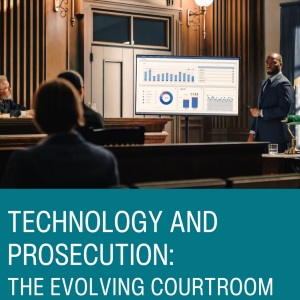
Advances in technology are quickly changing the longstanding practices of traditional courtrooms. With this evolution, prosecutors must weigh the opportunities these advancements create against the legal and ethical duties of criminal litigation, as well as the practical considerations about the quality and reliability of any emerging technology. From remote appearance technology to artificial intelligence to data analytics, we explore the role of technology in the modern courtroom in our recent publication:
Author: PCE
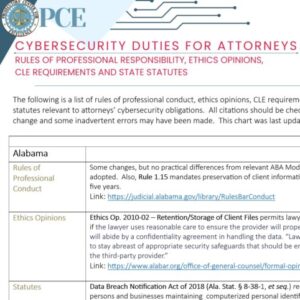
This publication provides a list of rules of professional conduct, ethics opinions, CLE requirements, and state statutes relevant to attorneys’ cybersecurity obligations.

Authors: PCE and AEquitas

Author: PCE

Authors: Arc, NAMI, PCE
Individuals with intellectual and developmental disabilities (I/DD) or mental illness are overrepresented in the criminal justice system, as victims, witnesses, suspects, and defendants. In an effort to inform prosecutors’ strategies when working with these individuals, PCE, in collaboration with the Arc and NAMI, has developed this guide.
The guide includes the following information:

Witness intimidation and witness tampering can occur in any case, from simple misdemeanors to homicides. It has a variety of consequences from the silencing of an entire community, to the murder of a witness, to the recantation of truthful testimony. Though witness intimidation is an insidious problem, there are strategies throughout the investigation and prosecution of a case that can help to keep a witness safe and reduce the impact of intimidation.
Authors: PCE

As part of PCE’s Quick Learning Series, Casey Gwinn of the Alliance for Hope International spoke to PCE’s Wendy Parker on investigations into “hidden homicides.”
Video Duration: 00:22:23
As part of Prosecutors’ Center for Excellence’s Quick Learning Series, Santa Clara County District Attorney (CA) Jeff Rosen spoke on how investigators in his office fight crime in partnership with law enforcement. Video Duration: 00:18:17

Establishing a Family Peace Center
As part of Prosecutors’ Center for Excellence’s Quick Learning Series, DA Kevin Barton of the Washington County District Attorney’s Office (OR), spoke on his office’s efforts to establish a Family Peace Center. Video Duration: 00:20:43


Survivor Justice Legislation: Through a Prosecutorial Lens
As part of PCE’s Quick Learning Series, Lisa Perlman, Chief of the Domestic Violence Survivors Justice Act (DVSJA) Unit in the Brooklyn District Attorney’s Office (NY) discusses survivor justice legislation. Video Duration: 00:15:51
Author: Antonia Merzon
Criminal justice practitioners are facing questions about emerging AI technology and how to use it appropriately. This article offers guidance for criminal justice practitioners interested in adopting GAI technology.