The Prosecutor’s Crime Analyst – An Essential Employee

Authors: PCE and Gaelin Bernstein
Read about the various essential tasks that a crime analyst can perform in a prosecutor office.

Authors: PCE and Gaelin Bernstein
Read about the various essential tasks that a crime analyst can perform in a prosecutor office.

Authors: PCE, NRTAC
This paper, developed by PCE’s Executive Director Kristine Hamann and St. Louis Circuit Attorney’s Office Chief of Trials Rachel Smith, addresses the critical question of how best to maximize the resources of a public forensic laboratory.
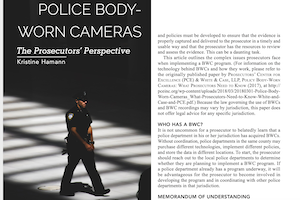
Author(s): Kristine Hamann
As police departments across the United States embrace the use of police body-worn cameras, the cameras will inevitably capture a great deal of evidentiary material that will be useful in every type of criminal prosecution.
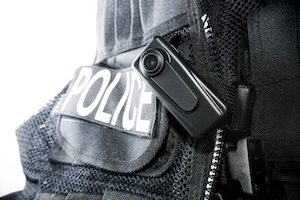
Author(s): Kristine Hamann, PCE
It is imperative that prosecutors be involved in the BWC uptake process as early as possible. The cameras will inevitably capture a great deal of evidentiary material that will be used in every type of criminal prosecution.
.
Author(s): Kristine Hamann, Rebecca Rader Brown
In May 2013, a Colorado man fails to show up to work. Concerned, the man’s boss visits his house, where the man’s roommate refuses to let the boss enter. The boss contacts the police, who launch a missing person investigation. Using cell tower technology, police are able to approximate the missing man’s location in the hours leading up to his disappearance.
Read More
This eyewitness identification toolkit provides prosecutors with an overview of the research behind witness memory and offers guidance for developing identification procedures. Prosecutors should take the lead in making sure that the identification procedures used in their state yield reliable, admissible evidence. The first step is to learn what procedures their police departments are using and to determine if they are fair and reliable.
June 23, 2016 — Volume 14
Around the country, prosecutors have supported the recording of custodial interrogations and have pushed for the creation of voluntary policies and, in some instances, endorsed legislation. Police have embraced this technology as well. The Colorado Best Practices Committee issued a report providing a national perspective on the progress made in this area.
Read MoreJanuary 14, 2016 — Volume 5
Police departments around the country are purchasing body worn cameras (BWC) at an accelerating pace. Prosecutors should get involved in this process as early as possible. Here is a brief overview of some of the issues prosecutors may consider. Also attached is a selection of model policies, articles and reports that provide more detailed information.
Read MoreSince 2014, Apple and Google’s new operating systems automatically encrypt their phones. This means that if law enforcement does not have the password, Apple or Google can no longer access the phone, even with a court ordered search warrant. The encryption may apply to some computers and laptops as well. So if a murder victim never divulged his or her passcode to anyone, or if a suspect refuses to disclose his passcode, the potential evidence or clues on the phone may remain permanently inaccessible.
Read More